
Pets Reacting to Empty Rooms: What It Usually Means

The dog stands in the hallway and growls at an empty bedroom. The cat freezes, stares at the ceiling corner, then bolts. A dog barking at nothing in the middle of the night can unsettle the whole house, and relatives may quickly suggest that animals see spirits. Pet owners in North York, Downsview and Vaughan ask me about this more often than you might expect. I understand the worry, and I also know how much more our animals hear and smell than we do. In this guide you will learn what a pet's senses pick up in a quiet room, the pests and household sounds that commonly trigger this behaviour, the health problems your vet should rule out, and what Hindu and other traditions say about animals and the unseen. You will also find a calm way to respond so that neither you nor your pet becomes more anxious. In more than forty years of practice I have learned that a sensible pest and vet check settles most of these worries long before any prayer is needed.
Why does my dog bark or growl at nothing?
Dogs hear far higher frequencies and fainter sounds than people, and their sense of smell is vastly more sensitive. What seems like nothing to you may be a mouse inside a wall, a raccoon on the roof, a neighbour's dog, an electronic whine or a scent drifting through a vent. Barking is their way of reporting it.
To your dog, an empty room is rarely empty. Their ears and nose turn up a world of signals that we simply cannot share.
- Hearing. Dogs detect ultrasonic sounds well above the human range. Rodents chirp at these frequencies, and many electronics, chargers and smoke or CO alarms with weak batteries emit a faint whine.
- Smell. A dog can pick up the trail of a mouse behind drywall, a dead insect, mould or a neighbour's cooking through the ventilation.
- Vibration. Footsteps from the unit above, trucks on the road and the furnace starting can be felt through the floor.
- Outside activity. Coyotes, foxes and raccoons are common across the GTA at night, and a dog may react to their scent or calls through a closed window.
- Reflections and light. Car headlights crossing a wall, a reflection from a watch or a moving shadow can trigger a bark.
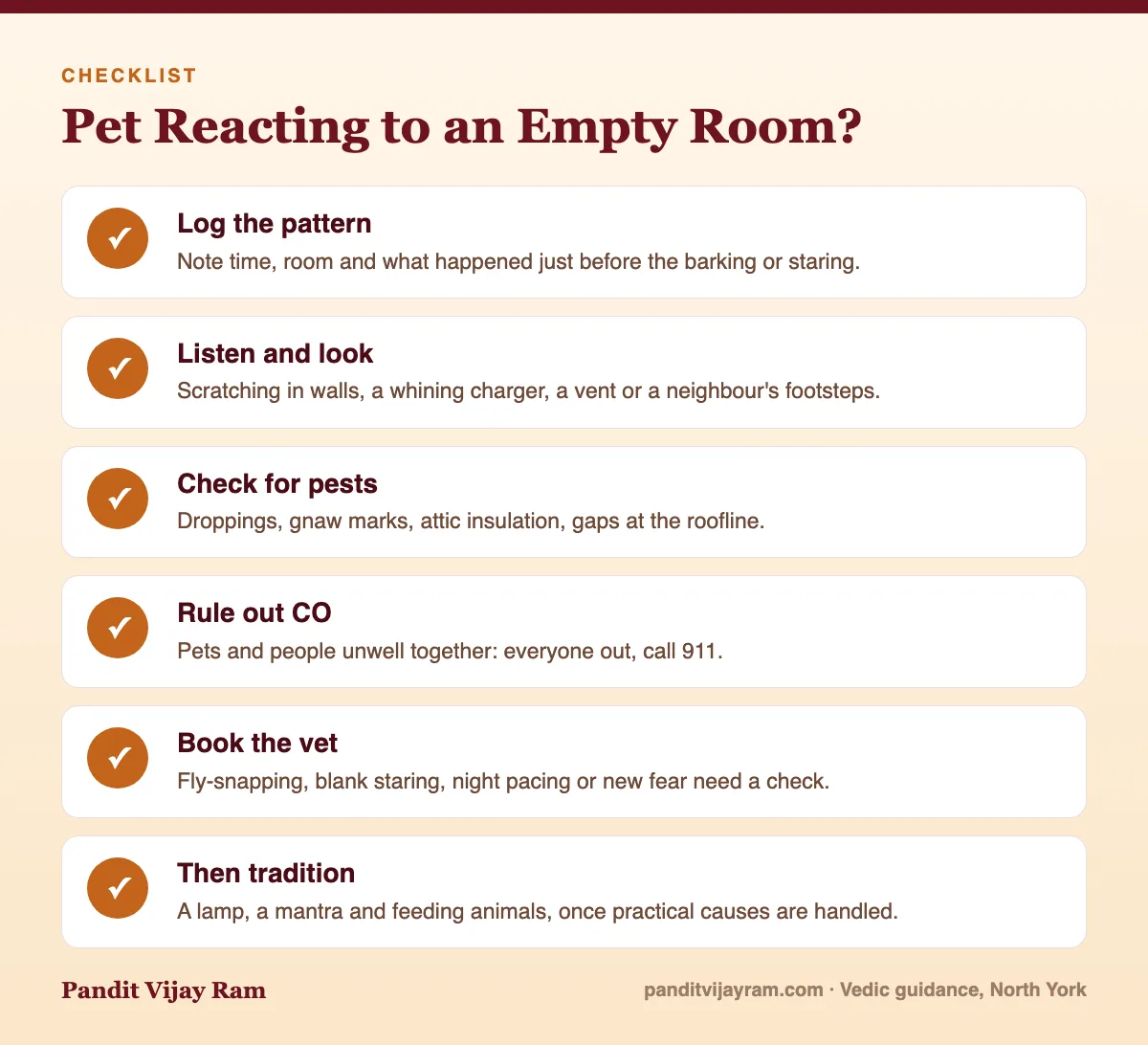
Try a simple investigation. Note the time, the room and what happens just before your dog reacts. Patterns appear: every evening at the same hour, only when the furnace runs, or always facing one wall.
Many families also wonder about protective customs for animals. The guide on nazar on plants and pets covers those gently.

Why does my cat stare at nothing or at the ceiling?
Cats hear sounds even higher in pitch than dogs and are expert at spotting tiny movements. Staring at a ceiling or corner often means they are tracking an insect, a dust speck in the light, or a mouse moving inside the wall. Sudden changes in staring, vocalising at night or confusion in older cats deserve a vet visit.
Cats are hunters by design. Their ears swivel independently, and they can locate a rustle with astonishing accuracy. A cat frozen in place and staring is usually doing exactly what it evolved to do.
Common reasons for staring
- Insects and spiders on the ceiling or behind a light fitting.
- Rodents in walls, ceilings or under floors, which are especially active in autumn and winter.
- Dust and light. Floating particles in a sunbeam, or a reflection that moves when a car passes.
- Sounds from neighbours through shared walls in condos and townhouses.
- Plain resting. Cats often sit gazing into space while listening, then lose interest.
When it may be a health issue
Older cats can develop thyroid problems, high blood pressure or cognitive decline, which may lead to night-time yowling, wandering and staring at walls. Eye disease and some neurological problems also change behaviour. If your cat seems disoriented, bumps into things, loses weight, or starts crying at night, book a vet appointment.
Respond calmly. Picking up a frightened cat or shouting at a barking dog teaches them the moment is dangerous. Speak softly, turn on a light and look at what they are watching. Very often you will find a moth, a reflection or a scratching sound in the wall.
How do I check for mice or animals in the walls or attic?
Look for droppings along walls and in cupboards, gnaw marks, greasy rub marks near holes, and shredded insulation or paper. Listen at night for scratching, scurrying or thumping in walls, ceilings and the attic. Squirrels are often active at dawn and dusk, mice and raccoons at night. Call a licensed pest control or wildlife removal service.
Pests are the most common hidden reason pets react to empty rooms, especially during cold Ontario months when animals seek warmth indoors.
A quick home check
- Kitchen and pantry. Look behind the stove and fridge and under the sink for droppings or chewed packaging.
- Basement and utility room. Check around pipes, the furnace and the water heater, where gaps often let mice in.
- Attic access. With a flashlight, look for trampled insulation, nesting material or droppings. Do not crawl into an attic you cannot walk on safely.
- Outside. Walk around the house looking for gaps at the roofline, damaged soffits, chewed vents and holes near the foundation.
- Listen. Sit quietly in the room your pet reacts to, at the hour it happens, and listen with your ear close to the wall.
Safety notes
- Wear gloves and a mask when cleaning droppings, and wet them with disinfectant first rather than sweeping them dry.
- Never use poisons where pets can reach them or eat poisoned rodents.
- Wildlife such as raccoons and squirrels should be handled by a licensed wildlife removal company, following provincial and city rules.
Once pests are dealt with, many pets stop barking at walls within days. Other house sounds that worry people are covered in haunted house signs versus old-house noises.
When should I take my pet to the vet for staring or barking at nothing?
See your vet if the behaviour is new and persistent, if your pet seems confused, anxious or in pain, if it snaps at the air, stares blankly or twitches, or if an older animal paces and cries at night. These can point to pain, vision or hearing loss, cognitive decline or seizures, all of which can be managed.
Animals cannot tell us when something feels wrong. Changes in behaviour are often their only signal.
Signs worth a vet appointment
- Fly-snapping or biting at the air, which can be a form of seizure in dogs.
- Blank staring with no response to their name, sometimes with lip-smacking or twitching.
- Night-time pacing, crying or getting stuck in corners in older pets, which may signal cognitive decline.
- Bumping into furniture or startling easily, suggesting poor eyesight or hearing.
- Restlessness, panting or guarding a body part, often a sign of pain.
- Sudden fear of a particular room, which can relate to a noise, a slippery floor or a bad experience there.
Act urgently if your pet collapses, has a seizure lasting more than a few minutes, or seems drowsy and unwell, especially if family members also have headaches or nausea. That combination can suggest carbon monoxide: get everyone, including pets, outside and call 911.
Many of these conditions respond to treatment, so an early visit can give your animal more comfortable years. Faith traditions value kindness to animals, and caring for their health is part of that duty. The feeling a presence in the house guide covers the carbon monoxide check in more detail.
Can animals sense spirits according to Hindu and other traditions?
Many traditions say animals perceive what people cannot. Hindu lore links dogs with Bhairava and with Yama's messengers, and Islamic teaching advises seeking refuge in God when dogs bark at night. These beliefs are held with respect. In my practice, they come after pest, household and veterinary checks, not before.
Animals hold a special place in Hindu thought. Dogs accompany Bhairava, a fierce protective form of Shiva, and appear in stories of Yama, the lord of death. Cows are revered, crows receive offerings during shraddh, and feeding animals is considered a meritorious act. In many Muslim households, a well-known teaching encourages believers to seek refuge in God when they hear dogs barking or donkeys braying at night. Caribbean and Latin American families also tell stories of animals warning their owners.
I share these beliefs respectfully and never mock them. I simply ask families to look after the animal and the house first, because an untreated pest problem or a sick pet will keep the behaviour going whatever we pray.
Gentle traditional steps, once checks are done
- Light a lamp at the family shrine morning and evening, and recite the Hanuman Chalisa or Om Namah Shivaya.
- Feed a street dog or donate to an animal shelter on a Saturday, a traditional act linked to Bhairava and Shani.
- Mop the room your pet avoids with water and a pinch of rock salt, then let your pet back in when it is dry.
- Keep the home calm: animals mirror our anxiety.
If unease in the home continues after pest control and a vet visit, a consultation can look at the wider picture. The negative energy removal page explains how that begins, and related guides are in the magic and entities hub.
The bottom line
A dog barking at nothing or a cat staring into a corner is usually reacting to sounds, smells or small creatures that people cannot detect. Check the house for mice, squirrels and raccoons, and note when and where the behaviour happens. New, persistent or confused behaviour needs a vet, and pets acting unwell alongside family headaches calls for a carbon monoxide check. Once those steps are taken, traditional prayer and kindness to animals can bring calm to the home.
Key takeaways
- Pets hear and smell far more than people, so empty rooms are rarely empty to them.
- Mice, squirrels and raccoons in walls or attics are common triggers.
- Fly-snapping, blank staring or night pacing deserve a vet visit.
- Pets and people unwell together can signal carbon monoxide; leave and call 911.
- Traditional beliefs about animals and spirits come after practical checks.