
Mangalsutra and Nazar: Black Beads and Marital Protection
A new bride in Brampton is told never to take off her mangalsutra, while her cousin in Markham wears hers only at weddings and Diwali. Both love their marriages, and both wonder who is right. People searching for mangalsutra black beads meaning usually want three things: the symbolism, the link to nazar, and some honest guidance on the rules. Families in North York and across the GTA ask me these questions often, sometimes after a clasp has snapped and someone at home has become anxious. This article explains what the sacred thread stands for, why black beads became the classic guard against the evil eye, how customs differ from Maharashtra to Tamil Nadu to Bengal, and what to do if a mangalsutra breaks. In more than forty years of practice, I have seen this ornament carry deep love. I have also seen it become a source of needless fear, and I would like to ease that fear here.
What is the meaning of a mangalsutra?
Mangalsutra comes from Sanskrit mangala, auspicious, and sutra, thread. It is tied by the groom around the bride's neck in a rite many South Indian families call mangalya dharanam. The thread stands for the couple's commitment and a prayer for the wife's long, healthy life together with her husband.
In many ceremonies the groom recites a short Sanskrit verse while tying the knot. A common version, beginning mangalyam tantunanena, says in essence: with this sacred thread, the reason of my life, I tie this around your neck, auspicious one; may you live a hundred autumns. Elders often add the second and third knots, or the groom's sister helps, depending on the community.
Three ideas sit inside the ornament:
- Commitment. The thread is tied in front of fire and family, alongside the seven steps of saptapadi.
- Blessing. It is a wish for well-being and togetherness, not a lock or a sign of ownership.
- Protection. Over time families came to see it as a shield for the marriage against envy, illness and quarrels.
Classical texts describe the wedding rites in detail but say little about the necklace itself. The mangalsutra as most people know it grew through regional and family practice, which is exactly why customs differ so much.
For the many other protective gestures at weddings, from haldi to the kala tika behind the ear, see nazar customs for brides and grooms. Couples who want to begin their marriage with a formal blessing can read about puja and havan services.
Why does a mangalsutra have black beads?
The black beads are believed to absorb nazar, the evil eye drawn by a new bride's beauty and good fortune. Black is the colour South Asian families trust most against envy, the same reason for a kala tika on a baby. A popular explanation also pairs the gold with Parvati and the black with Shiva.
A bride attracts more admiring looks than almost anyone. Traditional thinking held that this attention, however kind, could carry nazar, so the most visible piece of her jewellery took on the protective job. The black beads sit close to the heart and the throat, places people felt needed guarding.
Several layers of meaning are commonly given, and families mix them freely:
- Absorbing the eye. Black is thought to soak up envy before it reaches the wearer, as with black thread and kajal.
- Shiva and Shakti. In one popular reading, the black beads stand for Shiva and the gold for Parvati, making the necklace a picture of divine union.
- Steadiness. Some say the strung beads represent many small bonds holding a household together.
These are devotional interpretations, not rules from scripture, and they are all lovely in their own way. They do not mean that a woman without black beads is unprotected. Many Tamil, Kerala and Telugu brides wear no black beads at all.
The idea is closely related to other black-coloured guards against envy. Our guides on the kala tika custom and black thread on the ankle or wrist look at those practices and the skin safety points that go with them.
How do mangalsutra designs differ by region?
Black-bead chains with gold pendants are typical of Maharashtra, Gujarat, Rajasthan and Karnataka. Tamil and Kerala brides often wear a thaali or minnu on a yellow turmeric thread. Telugu families tie gold discs. Bengali and Punjabi brides traditionally mark marriage with bangles, sindoor and chooda rather than a necklace.
In the GTA you can see almost every variety at a single family wedding. A rough guide, with the caveat that families and castes within each region differ:
- Maharashtra: two small gold cups, vati, on strands of black beads, sometimes read as the two families joined.
- Gujarat and Rajasthan: black-bead chains with ornate pendants; Marwari families may add other marital jewellery.
- Karnataka: the karimani, a black-bead string, often worn with a gold pendant.
- Tamil Nadu: a thaali on a yellow thread, the manjal kayiru, its pendant shaped by community; many later move it to a gold chain.
- Kerala: Hindu brides often wear a small leaf-shaped thaali, while Syrian Christian brides receive a minnu.
- Andhra Pradesh and Telangana: two gold discs, one from each family, tied on a turmeric thread.
- Bengal: conch and coral bangles, shakha pola, an iron bangle and sindoor carry the meaning.
- Punjab: red and ivory chooda bangles after the wedding; a mangalsutra is a more recent addition for many.
Diaspora families often blend customs, especially in mixed-region marriages. None of these is more "correct" than another. What matters is that the couple and their families understand the meaning they are choosing to carry.
What does it mean if a mangalsutra breaks?
A broken mangalsutra is usually a worn thread, a weak clasp or a snag on clothing, not an omen. Tradition suggests gathering the beads respectfully, having it restrung or repaired soon, and offering a short prayer before wearing it again. It says nothing about the health of your husband or the future of your marriage.
Black-bead strings are often threaded on cotton or nylon that frays with daily wear, showers and a baby's grasping hands. Gold links thin at the hook. Most breaks happen at the clasp, which tells you where the stress was.
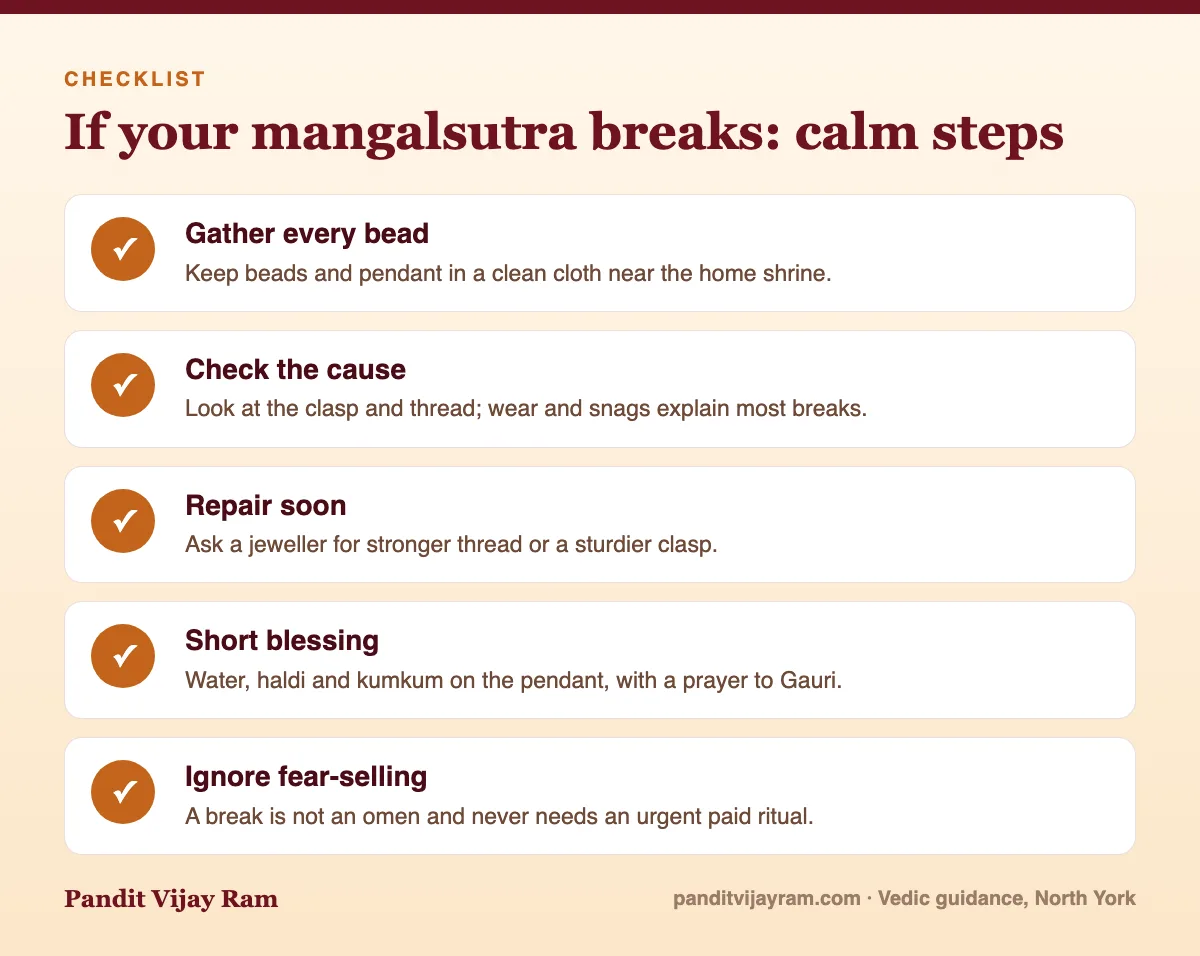
A calm sequence many families follow:
- Collect every bead and pendant and keep them in a clean cloth or a small box near your home shrine.
- Take it to a jeweller within a few days. Ask for a stronger thread or a sturdier clasp.
- Before wearing it again, sprinkle a little water, apply haldi and kumkum to the pendant, and say a short prayer to Gauri or your family deity.
- If the couple wishes, the husband can place it back around the wife's neck. This is a sweet custom, not a requirement.
Please do not let anyone tell you a broken mangalsutra means danger to your husband, or that you must pay for an urgent ritual. That is fear-selling. The same applies to evil eye beads, as discussed in what a broken evil eye bead means.
If the break happened during a tense period in the marriage and the incident has stirred up worry, a marriage problem consultation can look at the real issues with care. More protective customs are gathered in the evil eye and curses hub.
Is it okay not to wear a mangalsutra every day?
Yes. Many married women wear it only on festivals, family occasions or puja days, or choose a short chain, pendant or bracelet. Workplace safety, sports, medical scans and skin allergies are all sound reasons to take it off. The marriage is held in the relationship and its promises, not in a string of beads.
Older customs said a mangalsutra should never come off. Modern life in Canada brings situations where that is impractical or unsafe:
- Work: hospitals, factories, kitchens and labs often restrict necklaces for hygiene or entanglement risk.
- Medical care: metal must be removed for MRI scans and many procedures.
- Sport and swimming: chlorine and impact damage thread and gold.
- Skin: some alloys contain nickel, a common cause of itchy rashes; ask for higher-purity gold or a hypoallergenic chain.
Many women keep the mangalsutra in their shrine when not wearing it, and put it on for Karva Chauth, Teej, Varalakshmi Vratam or a family puja. Others wear a slim daily version and keep the wedding piece for occasions. Interfaith and inter-regional couples sometimes choose a symbol that honours both families.
One gentle caution: the mangalsutra should never become a tool of pressure. If a spouse or in-law uses it to monitor or shame you, the problem is in the relationship, not the necklace, and support is available. A wife who wears it with love and a wife who keeps it in a velvet box are equally married.
If you would like protection beyond jewellery, a personal nazar protection consultation can suggest simple prayers to keep at home.
The bottom line
Mangalsutra black beads meaning centres on protection: the beads are believed to draw away nazar from a bride and her marriage, while the thread itself carries a prayer for long life together. Regional customs differ widely, from black-bead chains to yellow-thread thaalis to bangles in place of any necklace. A broken mangalsutra is a repair job, not an omen, and choosing when to wear one is a personal decision that does not change the strength of a marriage.
Key takeaways
- Mangalsutra means auspicious thread, tied by the groom as a blessing.
- Black beads are traditionally believed to absorb nazar and envy.
- Many South Indian, Bengali and Punjabi brides use other marital symbols.
- A broken mangalsutra should be repaired calmly; it is not a bad omen.
- Wearing it daily or only on occasions are both valid choices.