
Broken Mannat or Unfulfilled Vow: What to Do Next

Families in North York often tell me about a broken mannat, a vow first made in a moment of need. A child is in hospital, a visa is pending, an exam result is days away, and someone in the family promises: if this works out, I will walk to the temple, feed a hundred people, offer a chadar at the dargah or shave my son's head at our village shrine. The wish comes true. Then life moves on, often to another country, and the promise slips away. Years later, a bad patch arrives and the memory returns with a jolt of guilt. It is among the most common worries I hear, and one of the easiest to resolve. This guide explains what a mannat or manauti is across Hindu, Sikh and Muslim practice, why tradition treats a late vow kindly, and what to do when the original promise can no longer be kept as spoken. It closes with a step-by-step way to fulfil or atone for it. In more than forty years of practice, I have never met a deity who held a grudge over a delayed coconut.
What is a mannat and why do people make vows to God?
A mannat, also called manauti, mannat-maangna or a vow, is a conditional promise made to a deity, saint or God: if my prayer is answered, I will offer something in gratitude. The offering might be a fast, a pilgrimage, food for the needy, a ritual for a child or a gift to a temple, gurdwara or dargah.
Vows like this appear in almost every faith the GTA's families practise.
- Hindu practice. Mannats are made at temples and shrines, often to a family deity, Hanuman, Ganesha, Vaishno Devi, Tirupati Balaji or a local devi. Offerings include coconuts, a set number of visits, a fast on a chosen weekday, or a child's first haircut at a particular temple.
- Sikh practice. Families may promise an Akhand Path, sponsor langar or offer karah prasad at a gurdwara once a wish is fulfilled. Many Sikhs frame this as gratitude in ardas rather than a bargain.
- Muslim practice. A nadhr or mannat may be made at a dargah, sometimes by tying a thread, with a promise to return, offer a chadar or feed people. Many scholars accept only vows made to Allah and for lawful acts.
- Christian practice. Caribbean, Latino and European families may promise a novena, a pilgrimage or a votive candle.
A vow is a form of vrata, a word that means both a resolve and a religious observance. It turns a desperate moment into a relationship of trust. That is why forgetting it feels so heavy later, and also why tradition is so ready to accept a sincere return.

What happens if a mannat is not fulfilled?
Tradition does not describe an unfulfilled mannat as a curse. It is seen as an unpaid debt of gratitude that weighs on the conscience. Some families believe it can cause obstacles until settled, but nearly every teacher agrees that fulfilling it late, with an apology, is fully acceptable. Fear is not the right response; follow-through is.
When someone comes to me sure that a forgotten vow has ruined their life, I start by separating two questions.
- What is actually going wrong? Job stress, health, a relationship or money trouble each need practical attention, and none of them is automatically connected to the vow.
- Is there an open promise? If yes, it is worth closing simply because you meant it, regardless of anything else happening.
This separation matters. If the vow is blamed for everything, people sometimes fulfil it and then feel betrayed when the job stress continues. If it is treated as one honest loose end, fulfilling it brings real peace of mind.
Some families report a feeling of heaviness lifting once a long-delayed vow is completed. That relief is genuine and worth having. It comes from keeping faith with yourself as much as with the deity.
If your worry has grown into a sense that the family is under a curse more broadly, the family curse and pitru dosh comparison helps sort out what kind of pattern you are seeing.
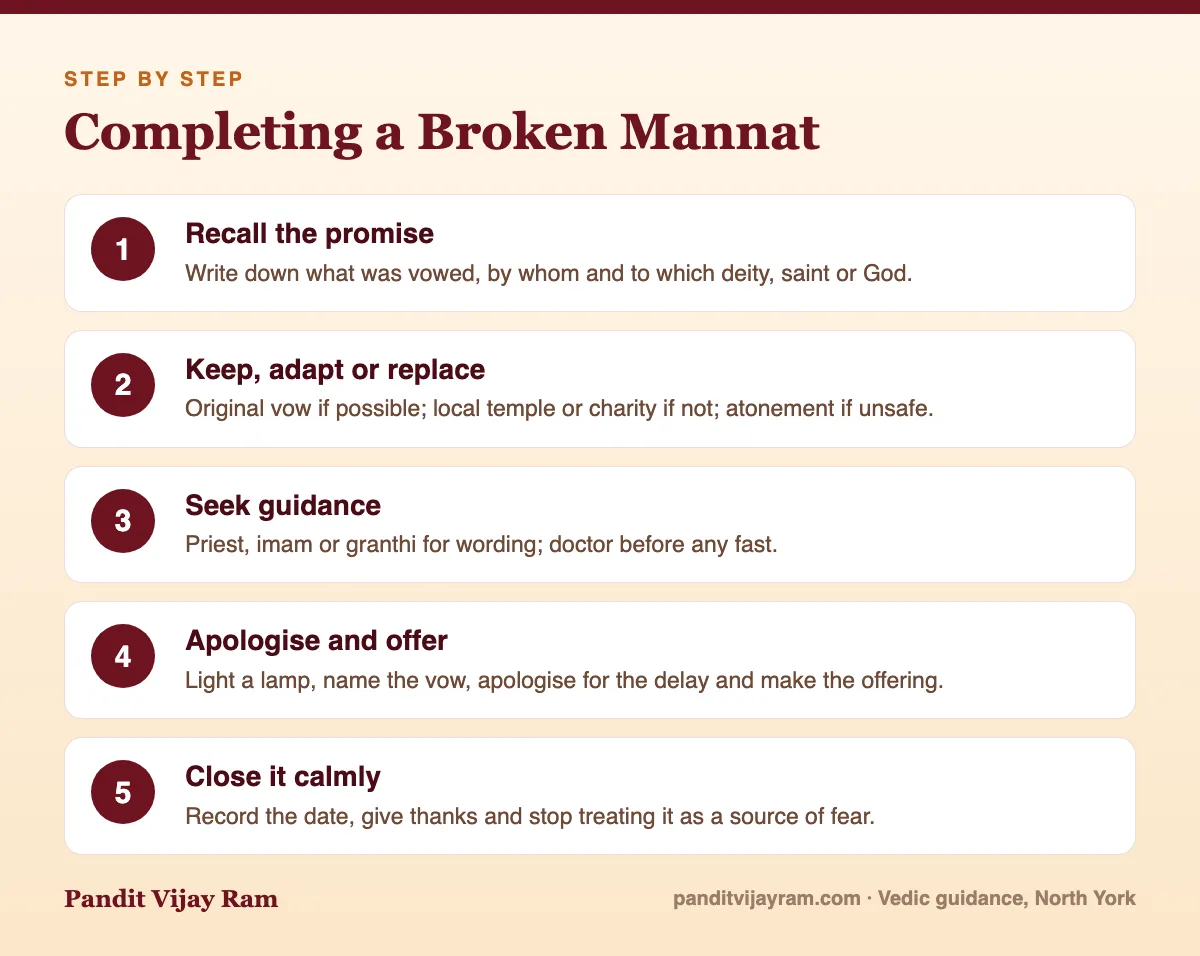
Can you complete a mannat late or at a different temple?
Yes, in most traditions. A late mannat is far better than none, and it can be completed with a simple apology for the delay. If the original temple or shrine is out of reach, many priests accept fulfilment at a local temple in the same deity's name, with a promise to visit the original place when possible.
Distance is the most common reason vows go unfulfilled among families who settled in Canada. A promise to walk to a hill shrine in Punjab or Andhra is not easy from Scarborough or Brampton.
Common, accepted adaptations include:
- Same deity, local temple. Offer the coconut, sweets or puja at a GTA temple where the deity is worshipped, stating the original vow in your sankalp.
- Postponed travel. Make a small offering now as a token, and keep the full pilgrimage for your next trip home.
- Equivalent charity. If the vow was to feed people at a certain shrine, feeding people through a Canadian food bank, langar or community kitchen keeps the spirit of it.
- Health-adjusted fasts. A vow of strict fasting can be adapted for diabetes, pregnancy or medication with a lighter observance. Ask your doctor first.
For a child's mundan or first-haircut vow at a specific temple, many families now perform the ceremony locally and later make an offering at the original shrine. A priest can help word this properly.
Where the vow was a puja or havan, a puja or anushthan arranged in your name can fulfil it with the original intention stated clearly.
What if you cannot keep the vow at all?
If a vow becomes impossible, unsafe or unlawful, tradition offers atonement instead. Hindu families use prayaschitta: an apology before the deity, charity, a short fast or japa. In Islam, many scholars apply kaffarah, such as feeding or clothing ten poor people, or fasting three days. Ask your priest, imam or granthi for guidance.
Some vows should not be kept as spoken. A promise made in panic might involve harming your own health, spending money the family no longer has, or an act no faith would truly endorse. Others become impossible when a shrine closes, a person dies or the condition changes.
In those cases, the honest path is to replace the vow, not to force it:
- Hindu approach. Light a lamp, state before the deity that you cannot keep the promise and why, ask forgiveness, and offer a prayaschitta that is within your means, such as a day of fasting, 108 repetitions of a mantra, or a donation.
- Muslim approach. Many scholars teach that a vow to do something sinful or harmful must not be fulfilled, and that expiation is given instead. Rulings differ, so consult a scholar you trust.
- Sikh approach. An ardas acknowledging the lapse, followed by seva at the gurdwara, is a common way to settle it.
Notice that none of these traditions asks you to pay a stranger to remove a vow-curse. If someone tells you a forgotten mannat has turned into black magic and quotes a large fee, treat that as a warning sign. Our negative energy consultations begin with whether there is any problem beyond the vow.
How do you avoid making vows you cannot keep?
Make vows that are simple, affordable, local and specific, and write them down. Many teachers suggest promising gratitude in a form you can deliver within weeks, such as a puja, a charitable gift or a set number of prayers. Some families prefer an unconditional offering, giving thanks without bargaining.
Most broken vows were made in a crisis by someone who expected life to stay the same. A few habits prevent tomorrow's guilt:
- Write it down. Keep a note in your phone or puja diary with the date of the vow, to whom it was made and what was promised.
- Tell one family member. If you become unwell or forget, someone else can help fulfil it.
- Keep it within reach. Choose offerings you could complete this month in the GTA, rather than a pilgrimage across the world.
- Avoid health risks. Do not promise long fasts, extreme vows or anything your doctor would advise against.
- Separate the vow from the outcome. Pray for help, and promise gratitude whatever happens. This removes the bargaining tone many teachers dislike.
Remember too that a promise made on someone else's behalf, such as a grandmother's vow for a grandchild, is often fulfilled by the family together. Elders are usually delighted when the next generation takes it up.
More guides on vows, curses and protection are collected in the evil eye and curses hub.
The bottom line
A broken mannat is a debt of gratitude, not a curse, and it can almost always be completed late with a sincere apology. When the original shrine or promise is out of reach, a local temple, equivalent charity or a guided atonement keeps the spirit of the vow. Making simple, written, achievable vows in future prevents the same worry from returning.
Key takeaways
- A mannat is a conditional promise of gratitude to a deity, saint or God.
- Tradition treats an unfulfilled vow as an open debt, not a curse.
- Late fulfilment, with an apology, is accepted in most traditions.
- Impossible or harmful vows are replaced through atonement, not forced.
- Write vows down and keep them simple, local and achievable.