
No Contact and Spiritual Remedies: Combining Both to Reconcile

The first weeks after a breakup are often the hardest to sit through. Your hand reaches for the phone a dozen times a day, and every silence feels like a message. Many people read about the no contact rule online and wonder whether it will make an ex miss them, or whether a puja could speed things along. Clients in North York and across the GTA ask me this almost weekly. This article explains what no contact really is, why it works best as a gift of space rather than a strategy, and how a simple daily spiritual routine can carry you through it. You will learn a practical plan, a decision rule for when reaching out might be reasonable, and the signs that say it is time to let go. In more than forty years of guiding families, I have seen that the people who use this quiet season to steady themselves are the ones who handle whatever comes next with dignity, whether that is reconciliation or a clean goodbye.
What is the no contact rule after a breakup?
The no contact rule means a set period, often several weeks, with no calls, messages, social media checking or visits to a former partner. It gives both people room to grieve, calm down and see the relationship honestly. Essential contact about children, shared leases or money continues, kept short and practical.
No contact is less about the other person and more about breaking a loop. After an ending, the mind replays conversations, refreshes profiles and searches for signs. Each check brings a small spike of hope or hurt, and the cycle keeps the wound open.
In practice, no contact usually includes:
- Muting or archiving the chat instead of rereading old messages.
- Not viewing their stories, posts or friends' photos.
- Asking mutual friends not to pass on news for a while.
- Returning belongings through a friend, or in one brief, polite exchange.
Where you share children, a home or a business, full silence is not possible or fair. Keep those messages factual and kind, and handle emotional topics later, perhaps with a mediator. Our article on love after divorce or separation covers the legal and parenting side in more detail.
Spiritually, this period resembles a vrata, a vow of restraint. Restraint is not punishment. It is a way of letting the mind settle so that any later decision comes from clarity rather than panic.

Is no contact a way to make an ex come back?
It should not be used that way. No contact can give a former partner space to reflect, and sometimes reflection leads to a conversation. But treating silence as a trick turns care into manipulation. The honest aim is your own healing, with full respect for whatever your ex decides.
Many online guides sell no contact as a psychological lever that makes someone desperate to return. That framing causes real harm. People count the days like a countdown, then feel betrayed by the silence they chose when the ex does not reach out on schedule.
In the Vedic view, a prayer or practice that aims to bend another person's will collects its own consequences. Vijay Ram ji does not offer rituals to override a partner's choice, and he does not suggest timing your silence like bait. What he does suggest is praying for the wellbeing of both people and for the right outcome, whatever it turns out to be.
A useful test is to ask yourself these questions each week:
- Am I doing this to heal, or to win?
- Would I be at peace if they never wrote again?
- Am I keeping my life moving, or just waiting?
If the answers lean towards winning and waiting, shift your practice towards release. The cord-cutting guide for past relationships can help with that. Our piece on honest signs of reconciliation explains how to tell genuine change from wishful reading.
What spiritual practice can I do during no contact?
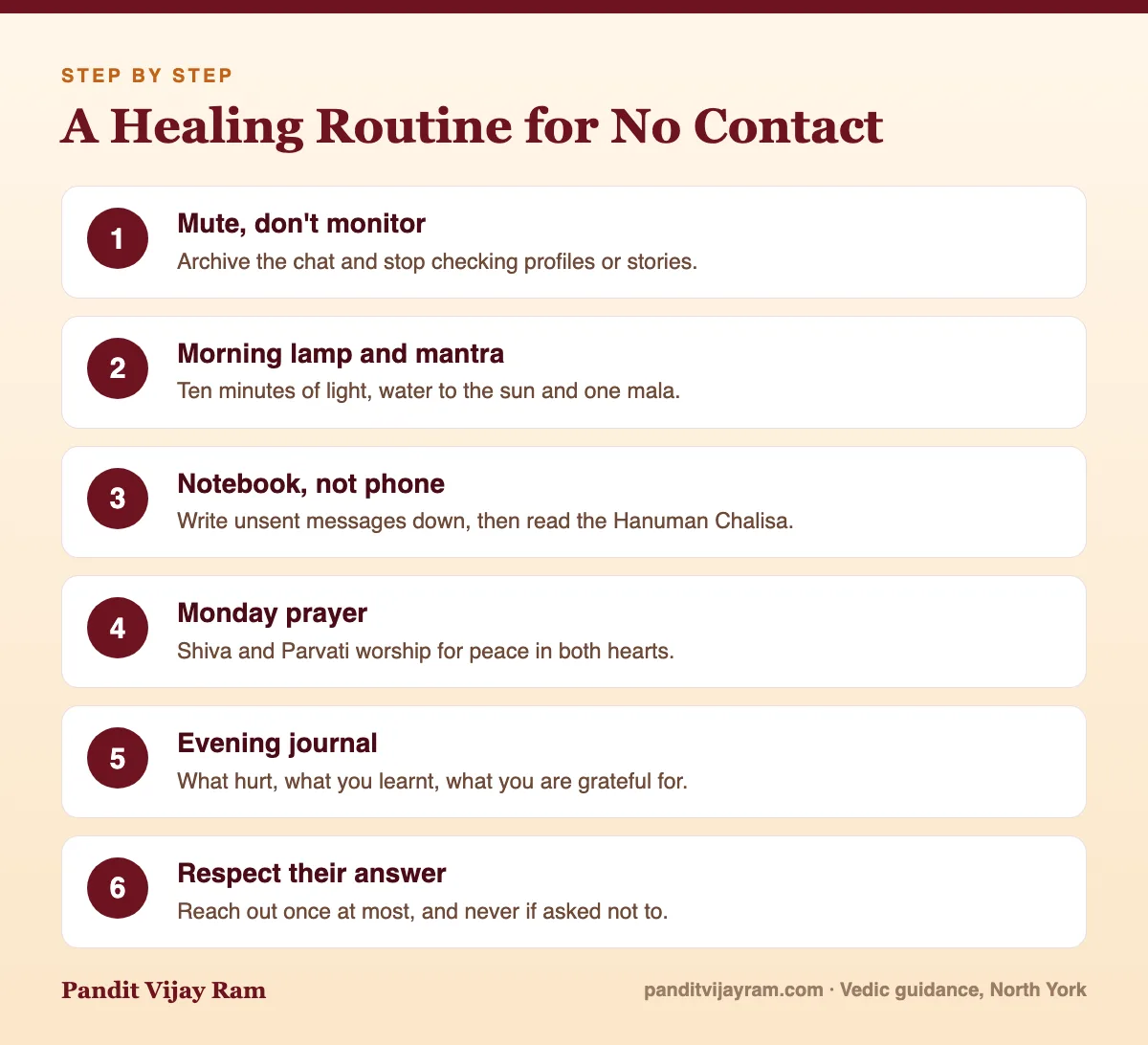
Keep a short daily routine: a morning lamp and prayer, a mantra such as the Gayatri or Om Namah Shivaya, a few lines of journalling, and one act of service. Monday Shiva worship suits emotional steadiness. The routine should fill the space the phone once took, not become another way to obsess.
A routine works best when it is small enough to keep on a bad day. One plan clients find manageable:
- Morning, ten minutes: light a lamp, offer water to the rising sun, and chant one mala of Om Namah Shivaya or the Gayatri mantra.
- When the urge to text strikes: write the message in a notebook instead, then read the Hanuman Chalisa once. The urge usually passes before you finish.
- Monday: offer water or milk to a Shivling, or simply sit before an image of Shiva and Parvati, praying for peace in both hearts.
- Evening: three lines in a journal: what hurt, what you learnt, what you are grateful for.
- Weekly: one act of seva, such as helping at a temple kitchen or food bank.
Sleep, meals and movement matter as much as prayer. A walk in a ravine trail or local park does more for a racing mind than another hour scrolling. If your home feels heavy after arguments, the article on clearing energy after a breakup gives a gentle room-by-room method. For chart-based support, the get ex love back consultation pairs prayer with counselling and a realistic look at timing.
How long should no contact last before I reach out?
There is no fixed number. Many counsellors suggest at least several weeks, and longer after a painful or unsafe ending. A better guide is your state of mind: reach out only when you could accept any answer calmly, and never if they asked you not to.
Use this decision rule before breaking the silence:
- Do not reach out if they asked for no contact, blocked you, or the relationship involved threats, control or violence. Respect that boundary completely.
- Wait longer if you still check their profiles daily, cry at reminders, or are writing messages in your head.
- Consider one message if you are sleeping and eating normally, have accepted that it may be over, and have something honest to say, such as an apology.
If you do write, keep it short, warm and free of pressure. Something like, "I've been thinking about how I handled things and I'm sorry for my part. No need to reply." Then let it be. A single unanswered message is an answer, and sending more erodes self-respect.
Astrology can add context. A reading may show a Saturn or Rahu period that favours patience, or a lighter transit suited to calm conversation. Timing is a support, not a switch; it cannot override what the other person feels. The article on how long love back remedies take explains why quick timelines are a warning sign.
When should I stop waiting and get help to move on?
Seek help if months pass and you still cannot eat, sleep or work properly, if you feel hopeless, or if you are tempted to follow or confront your ex. A family doctor or counsellor can help with grief and anxiety. Prayer then supports release rather than reunion.
Some heartbreak needs more than routine and mantra. Please reach out for support if you notice:
- Weeks of poor sleep, appetite changes or trouble concentrating at work or school.
- Thoughts that life is not worth living. Call or text 9-8-8, Canada's Suicide Crisis Helpline, at any hour.
- Urges to drive past their home, create fake accounts or contact their new partner.
- Drinking more or using substances to get through evenings.
Those urges are common in grief, but acting on them can frighten the other person and may become harassment. A counsellor can help you manage them without shame. If your former partner is the one following or threatening you, call the police and save the evidence.
On the spiritual side, release is a real practice, not a defeat. Offering a written letter to the flame of a lamp, then dissolving the ashes in flowing water, is one traditional way to mark an ending. When people are ready, Vijay Ram ji can read the chart for the next chapter rather than the last one, through the relationship compatibility service when a new partner appears.
The bottom line
The no contact rule works best as a season of space and restraint, not a trick to pull someone back. Pair it with a small daily routine of lamp, mantra, journalling and seva so the hours once spent on the phone become hours of healing. Respect your former partner's decision, reach out only when you could accept any answer, and seek a doctor, counsellor or the police when grief or safety calls for it.
Key takeaways
- No contact gives both people room to think; it is not a lever.
- A ten-minute daily routine can replace compulsive checking.
- Never break silence if they asked for space or the relationship was unsafe.
- One calm, pressure-free message is the most you should send.
- Release is a genuine spiritual practice when reunion is not the answer.