
Radha Krishna Puja for Love and Devotion
Radha and Krishna are the couple most Hindus picture when they think of love. Their images sit in wedding halls, on calendars in family kitchens and in mandirs from Vrindavan to the GTA. So it is natural that people ask me about a Radha Krishna puja for love, whether they are single, newly engaged or struggling in a long marriage. Families in North York and across Toronto often keep a small Radha Krishna murti at home already, and want to know how to worship with more meaning. This guide explains what the Radha Krishna bond signifies in Vaishnava devotion, what a puja for love really asks for, a simple home method you can follow, the traditional days, and how couples can pray together. In more than forty years of Vedic practice I have seen this worship soften hearts, but always the worshipper's own heart first. Radha's love asks nothing of Krishna but his presence. That is the spirit in which the puja is best offered, and the reason it is never used to pull another person towards you.
What does the love of Radha and Krishna mean in Hindu devotion?
In Vaishnava devotion, Radha and Krishna represent the soul's longing for the divine and the divine's delight in that longing. Radha is honoured as the highest devotee, and in several traditions as Krishna's own power of joy. Their love is read as a model of devotion that gives freely, rather than as an ordinary romance.
The stories come mainly from Vraja, the pastoral country around Vrindavan, where the young Krishna played the flute and the gopis, the cowherd women, left everything to be near him. The Bhagavata Purana tells of a favoured gopi without naming her. Later poets, especially Jayadeva in the Gita Govinda, gave Radha her central place and her voice.
Different schools read the pair in their own way:
- Gaudiya Vaishnavas, the tradition of Chaitanya and of ISKCON, see Radha as Krishna's hladini shakti, the energy of bliss, inseparable from him.
- The Nimbarka and Vallabha traditions worship the pair together with deep sweetness, and Pushtimarg seva centres on Krishna as Shrinathji.
- In Maharashtra, devotion often turns to Vitthal and Rakhumai rather than to Radha, a reminder that regional customs differ.
Notice that in most tellings Radha and Krishna are not husband and wife; Krishna's wedded queens are Rukmini and others. That is a clue to the meaning. Their love is about longing, surrender and joy, the bhava of the heart, not about possession. When you pray to them for love, you are asking for that quality in yourself.
What does a Radha Krishna puja for love ask for?
A Radha Krishna puja for love asks for a heart that loves generously, patience and sweetness in a relationship, and harmony that both partners already want. For a single person it can ask for readiness to meet a good partner. It does not ask for a particular person to be drawn, bound or brought back against their wishes.
I explain the purpose to clients through three short prayers they can choose from, depending on where they are in life:
- For a single person: may I become someone who can love well, and may I recognise a good partner when we meet.
- For a couple: may we speak to each other with sweetness, forgive quickly and grow in devotion together.
- After a loss: may my love become less grasping, and may the person I lost be well wherever they are.
All three ask for change in the one who prays. That is the line I hold in every love-related practice. Rituals that try to override another person's free choice are against the spirit of bhakti and, in my view, against basic respect. The article on prayer rather than binding in marriage explains this line in more detail, and the Kamdev and Rati puja guide covers a related tradition of love prayer with the same boundary.
When a couple is struggling, prayer is most helpful alongside honest conversation and, where needed, a counsellor. Some couples also find a relationship compatibility reading useful for understanding each other's temperament, provided both people have agreed to it.
How do you do Radha Krishna puja at home?
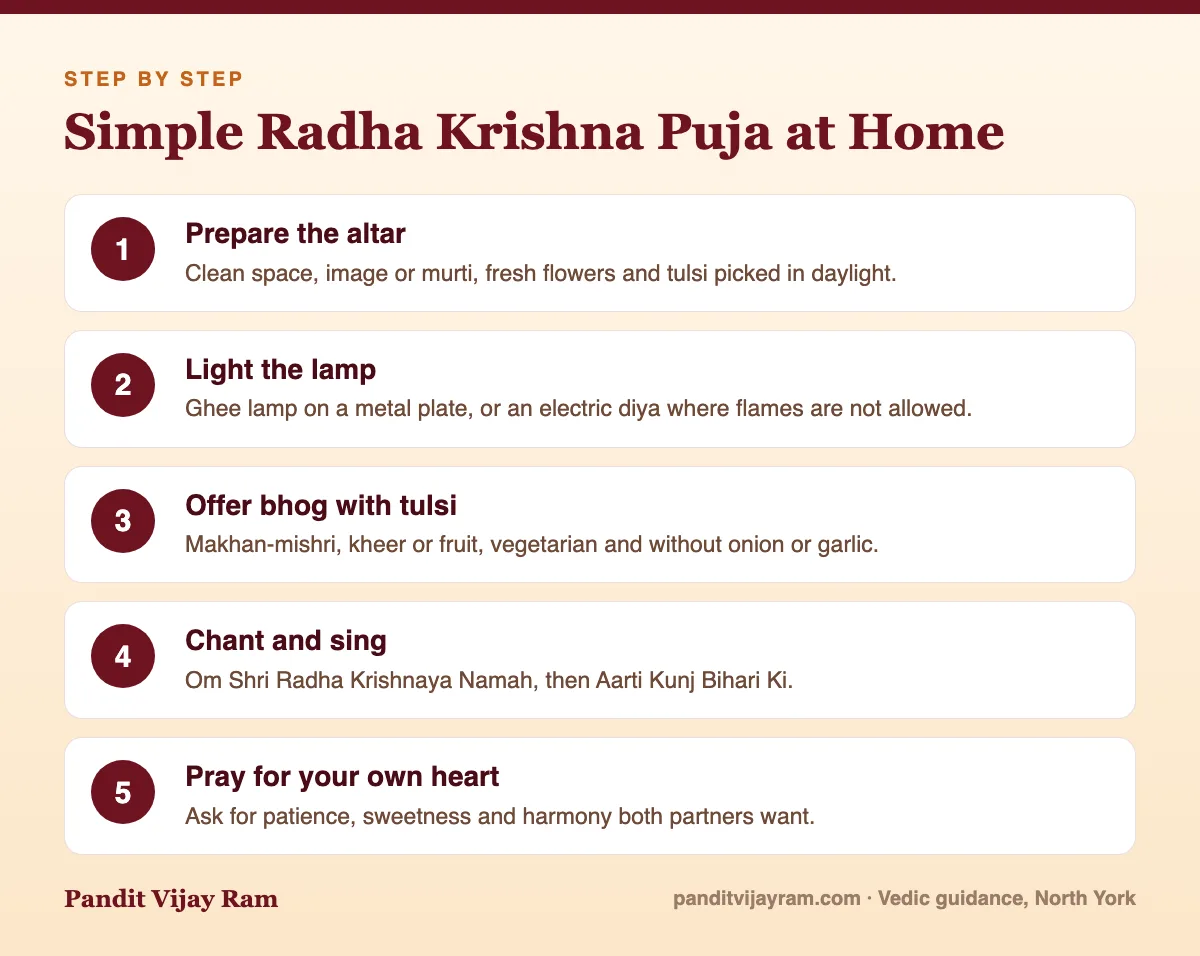
Clean the altar, bathe and wear fresh clothes, then light a ghee lamp before an image or murti of Radha and Krishna. Offer water, flowers, tulsi leaves and a sweet such as makhan-mishri, chant Om Shri Radha Krishnaya Namah or the maha-mantra, sing the aarti, and close with a quiet personal prayer.
The home method below follows common North Indian practice. Your family's custom may differ, and that custom comes first.
- What you need: an image or small murti, a ghee lamp, incense if your home allows it, fresh flowers (yellow and white are traditional), tulsi leaves, a small bowl of water, and a simple bhog such as butter with sugar crystals, kheer or fruit.
- Tulsi: it is placed on food offered to Krishna. Many families avoid plucking tulsi after sunset or on Ekadashi, so pick leaves the day before if needed.
- Dress: a small piece of yellow cloth for Krishna, the pitambar, and red or pink for Radha are common touches, not requirements.
- Mantra: Om Shri Radha Krishnaya Namah, the maha-mantra, or simply Radhe Radhe. Choose one and repeat it with attention.
- Aarti: Aarti Kunj Bihari Ki is widely sung; any aarti you know with devotion is fine.
Fire safety matters. Keep the lamp on a metal plate, away from curtains, and never leave it burning unattended. In a condo or rental, an electric diya with a short incense-free puja is perfectly acceptable. Afterwards, share the bhog with family as prasad. If you would like a priest to perform a fuller puja or anushthan, see puja and anushthan services.
Which days are best for Radha Krishna worship?
Janmashtami, Krishna's birth on the eighth day of the waning fortnight, and Radhashtami, Radha's appearance about fifteen days later on the eighth day of the waxing fortnight, are the main festivals. Ekadashi days and the spring festival of Holi are also traditional. Daily worship at any time is welcome; check a Toronto panchang for exact dates.
Lunar months are named differently in the north and south of India. In the amanta calendar used in much of the south and west, Janmashtami falls in Shravana; in the purnimanta calendar common in the north, the same night falls in Bhadrapada. The festival is the same; only the month label changes. Because local moonrise and tithi timings differ, it is best to use a panchang prepared for Toronto rather than one for Delhi or Mumbai.
Traditional observances include:
- Janmashtami: a fast for those in good health, bhajans, and a midnight aarti for Krishna's birth.
- Radhashtami: worship of Radha, often with a midday puja and lotus or rose offerings.
- Ekadashi: a fast or light diet and extra chanting for Vishnu and his forms.
- Holi and the spring season: songs of Radha and Krishna's playful love, sung in many Vaishnava communities.
For a couple, some families also choose a Friday for shared prayer, since Friday belongs to Shukra, the planet of love and harmony. The Friday vrat guide explains that custom and its health cautions. Fasting is never required for this puja; a sincere offering is enough.
Can couples do Radha Krishna puja together?
Yes. Couples often find a short weekly Radha Krishna puja a calm way to begin a shared ritual: one lamp, one mantra, a few words of gratitude each. It works best when both partners want to take part. It is a support to communication and counselling, not a substitute for them, and never a cover for abuse.
A shared practice gives couples a few minutes each week when neither is checking a phone or arguing about logistics. Here is a simple format many couples like:
- Light the lamp together and chant the maha-mantra or Radhe Krishna eleven times.
- Each partner names one thing they appreciated about the other that week.
- Each names one thing they will try to do better, about themselves only.
- Offer the bhog and eat it together as prasad.
The rule in step three matters. Prayer is not the place to list a partner's faults. The couples cleansing practice uses the same principle with a shared lamp and joint sankalp.
Be honest about limits. A puja cannot fix a relationship where one person is controlling, threatening or violent, and nobody should be told to pray harder in that situation. Safety and outside help come first. In ordinary difficulties, a couples counsellor and the marriage problem guidance Vijay Ram ji offers can sit alongside your prayer.
The bottom line
A Radha Krishna puja for love draws on a devotional model of love that gives freely and does not possess. The home method is simple: a lamp, tulsi, flowers, a sweet offering, a mantra and an aarti, kept safely and in your family's style. Janmashtami, Radhashtami and Ekadashi are traditional, but any day of sincere worship is welcome. Couples can pray together, alongside honest conversation, and the prayer always asks for change in the heart of the one who prays.
Key takeaways
- Radha and Krishna represent devotional love that gives freely, not ownership.
- The puja asks for a purer capacity to love, never for control over a person.
- A home puja needs only a lamp, tulsi, flowers, a sweet and a mantra.
- Janmashtami and Radhashtami are the main festivals; check a Toronto panchang.
- Couples can share a weekly puja, alongside counselling where needed.