
Reuniting With a First Love

A name appears in your messages after many years. Or a cousin mentions that your school sweetheart is divorced now and living in Brampton. Suddenly you are sixteen again, remembering a walk home, a song, a promise. The wish to reunite with first love is one of the most tender longings people bring to me in North York, and it often arrives with confusion, guilt or a rush of hope. This article walks through it carefully. It explains why first love holds such power in memory, how to tell nostalgia from present-day compatibility, what to do if one of you is married, how families tend to react when old flames return, and how to reconnect slowly if you are both free. I have sat with people from many communities over more than forty years, and I have seen first loves rekindle into warm, grounded marriages. I have also seen people chase a memory and lose a good present life in the process. The difference usually lies in honesty: with yourself about what you are really missing, and with everyone who would be affected by your choice.
Why is a first love so hard to forget?
First love usually happens during adolescence or early adulthood, when emotions are intense and identity is forming. Memories from those years tend to be vivid and are recalled often. Many first loves also end because of outside forces such as parents, distance or exams, leaving a story that feels unfinished rather than truly concluded.
There are good reasons why a first love can stay with someone for decades.
- Everything was new. The first time you felt chosen, the first heartbreak, the first secret. New experiences leave deep traces in memory.
- It shaped who you became. Psychologists note that people tend to recall more memories from their teens and twenties than from other periods of life, because those years build our sense of self.
- It often ended unfairly. In many South Asian, Caribbean and Latino families, young relationships were ended by parents over caste, religion, studies or reputation. When a romance is stopped rather than finished, the mind keeps returning to it.
- Memory softens. Over time we tend to remember the sweet moments and forget the arguments, the jealousy and the immaturity. This is sometimes called rosy retrospection.
None of this means the feelings were not real. They were. But the person you loved at seventeen and the person who might message you now have lived very different lives since. So have you.
Recognising the power of nostalgia is not a reason to dismiss a reunion. It is a reason to meet the present person with open eyes. If you are thinking about someone from a more recent relationship after a long gap, our guide on getting back together after years apart covers that situation more directly.

Is it a good idea to reunite with your first love?
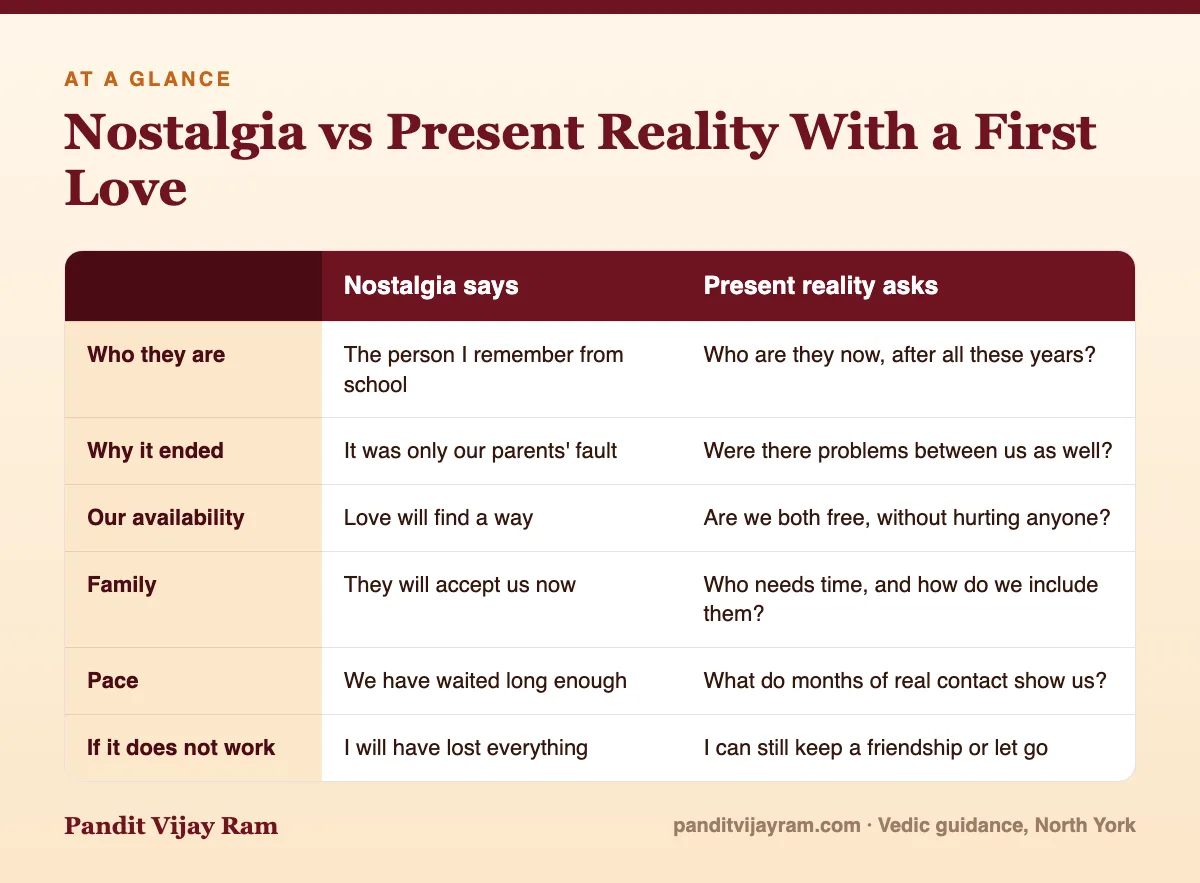
It can be, when both people are single, emotionally available and curious about who the other has become rather than who they were. It is unwise when you are mainly escaping a difficult present, when either person is married, or when you are chasing a feeling instead of getting to know a real adult with a different life.
Before you invest your heart, ask yourself these questions honestly:
- Am I free? Single, separated with finalised arrangements, divorced or widowed, and ready rather than still grieving?
- Are they free? If not, the conversation stops here.
- What do I actually know about them now? Their values, faith practice, work, children, health and plans.
- Why did it end the first time? If it was parents, distance or age, those may have changed. If it was dishonesty or incompatibility, those may not have.
- What am I hoping to feel? Young again, chosen, rescued? Those are understandable wishes, but no person can carry them for you.
- Could I enjoy a friendship if romance does not follow?
A first love reunion has the best chance when the answers are grounded in the present. Treat early conversations like getting to know someone new who happens to share a past with you. Notice who they are when they are tired, disappointed or disagreeing.
If you would like a gentle second view on compatibility, a relationship compatibility reading can compare both charts, looking at the seventh house, Venus and Moon signs. It describes tendencies, not a verdict, and works best alongside time spent actually getting to know each other again.
What if your first love comes back after you are married?
If you are married, the most honest course is not to pursue a secret reconnection. Talk to your spouse or a counsellor about what the contact has stirred up, and limit private messaging. If your first love is married, do not try to draw them away. Strong feelings are human; acting on them behind someone's back causes serious harm.
This is one of the most common situations people describe to me, and one of the most painful. A first love reaches out on social media, or you meet at a wedding back home, and old feelings return with surprising force.
Some principles that protect everyone:
- Feelings are not actions. Noticing a pull towards someone does not make you a bad person. What you do next is what matters.
- Avoid secrecy. Private late-night chats, deleted messages and hidden meetings are the usual path to an emotional or physical affair.
- Look at your marriage honestly. Often the intensity of a first-love reunion reveals loneliness or distance at home. That deserves attention, ideally with your spouse and a counsellor. Our marriage problem consultation can support that work.
- If your first love is married, step back. Do not encourage them to leave their spouse or children for you, and do not ask anyone to perform a ritual to separate them.
- If you decide your marriage is over, end it honestly and legally first, with care for children, before beginning anything new.
In dharma, marriage is a vow made before Agni and family. That does not mean anyone must stay in an abusive or loveless marriage. It means changes should be made openly, with respect for the people already committed to you.
I decline requests to bring a married first love back. What I can offer is clarity about your own chart and prayer for honesty and peace in your home.
How do families react when first loves reunite later in life?
Reactions vary widely. Some parents regret ending the original relationship and welcome a reunion. Others still object for the same reasons as before. Adult children from earlier marriages may feel protective or unsettled. Expect mixed feelings, give people time to adjust, and remember that as an adult the decision is yours and your partner's.
Families often played a central role in how first loves ended, so they will likely have opinions when one returns. Some common scenarios in diaspora households:
- Parents who forbade it now regret it. Ageing parents sometimes soften and admit they were driven by fear of community judgement. A reunion can become a quiet healing for them too.
- The old objection remains. Caste, religion or region may still matter to some relatives. Our guide on inter-caste marriage and parents' approval discusses these conversations and your legal right to choose a partner in Canada.
- Adult children have feelings. If either of you has children from a previous marriage, they may worry about loyalty to their other parent, inheritance or simply change. Listen without letting them veto your life.
- Community talk. Gossip about an older couple reuniting can be unkind. Choose who to tell and when.
For couples reuniting in midlife, practical matters deserve calm discussion: where you would live, finances, care for elderly parents and how blended families would work. Our article on marriage after forty addresses many of these.
Take introductions slowly. A relaxed family meal often works better than a formal announcement. Let relatives meet the person as they are today, not the teenager they once disapproved of.
How do you reconnect with a first love slowly and honestly?
Start with light, open contact if you are both free, meet in public, talk mostly about the present rather than the past, and let trust build over months rather than weeks. Be honest about your life now, including children, health and finances. If either of you hesitates, respect it. A real reunion can survive a slow pace.
Rushing is the most common mistake in first-love reunions. The emotional memory is so strong that couples sometimes talk about marriage within weeks. A steadier approach:
- Begin as acquaintances. A friendly message, a phone call, a coffee in a public place. No declarations.
- Talk about now. What do you each do on a normal Tuesday? What matters to you? What has life taught you?
- Share the hard parts. Previous marriages, losses, debts, health conditions, children. Honesty early prevents painful surprises later.
- Notice old patterns. If the same jealousy or misunderstanding from your teens appears, address it directly.
- Respect hesitation. If they want time, give it. If they decide not to continue, accept it with grace.
Some couples like to mark a reunion with prayer. A simple visit to the temple together, a Ganesha puja for a fresh start, or Friday prayers associated with Venus for harmony are traditional ways to ask for blessings on a relationship that both people have freely chosen.
If the reunion does not happen, or your first love has moved on, that grief is real too. A get ex love back consultation can help you understand this season and find peace with either outcome, without any attempt to influence the other person's heart.
The bottom line
Choosing to reunite with first love can bring real joy when both people are free and willing to know each other as they are now. Nostalgia makes early romance shine, so ground every step in present-day honesty and a patient pace. If either of you is married, step back and attend to your own home first. Families may need time, but as adults the choice belongs to the two of you.
Key takeaways
- First love feels vivid because it happened while identity was forming.
- Memory tends to soften the hard parts of early relationships.
- Get to know the person as they are today, not as you remember them.
- If either of you is married, do not pursue a secret reconnection.
- A slow, honest pace protects a reunion that is meant to last.