
Long-Distance Relationship With Someone in India

Some of the warmest love stories I hear began with a cousin's wedding in Punjab or a chance chat with someone in Chennai. Some of the most painful began the same way. If you are in a relationship with someone in India while living in Canada, you carry hopes and practical questions at the same time. I hear these from young people and their parents in North York and across the GTA. When can we talk? What will our families say? Who moves, and how? How do I know this person is real? This guide covers the time difference and how couples use it, the role of families on both sides, what to know about visas and sponsorship without legal advice, warning signs of romance scams and relationships of convenience, and when to meet in person. In more than forty years of Vedic practice I have seen cross-border love grow strong when both people are patient and honest. I have also seen it fail when one person was hurried, flattered or asked for money too soon.
How do you manage the time difference with someone in India?
India Standard Time is five and a half hours ahead of UTC and does not change for daylight saving. Ontario does, so India is nine and a half hours ahead during Ontario's summer time and ten and a half hours ahead in winter. Toronto evenings meet Indian mornings, and Toronto early mornings meet Indian evenings.
The gap means one of you is usually tired when the other is fresh. Couples who manage well plan around it rather than fighting it.
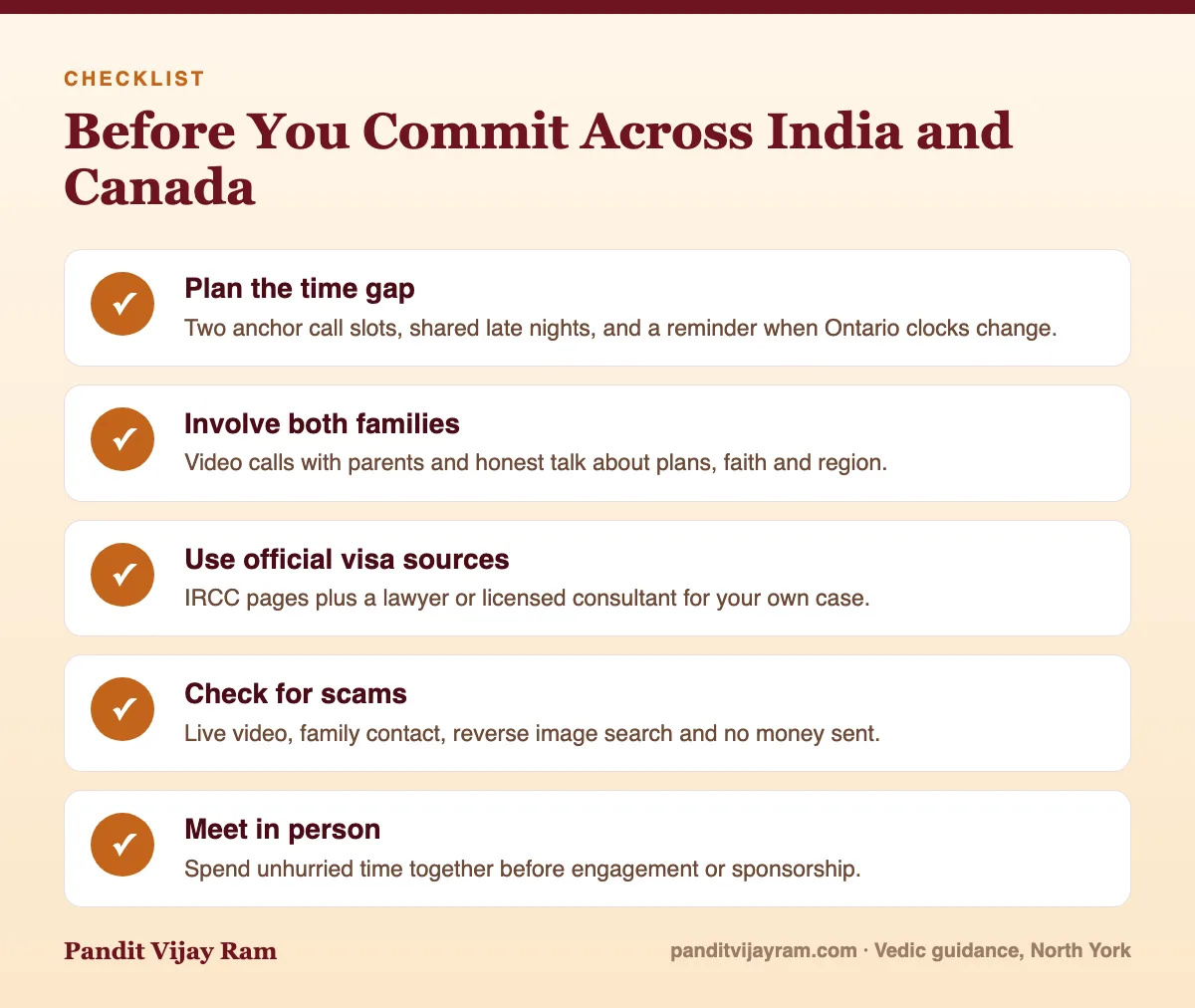
- Pick two anchor slots. A Toronto early morning call, before work, reaches India in the evening. A Toronto late evening call reaches India the next morning.
- Watch the clock change. When Ontario moves its clocks in spring and autumn, your usual slot shifts by an hour in India. Put a reminder in both calendars.
- Share the sacrifice. If one person always stays up late, resentment builds. Take turns.
- Use voice notes. Short messages left for the other's morning keep contact warm without waking anyone.
- Plan festivals. Diwali, Lohri, Pongal or Eid may fall at awkward hours. Agree in advance when you will call.
Our earlier guide to long-distance relationship problems covers communication habits and shared prayer across distance. This post focuses on what is particular to India and Canada.

How do families in India and Canada affect the relationship?
Family approval often matters a great deal on both sides. Parents in India may worry about their child moving abroad, while parents here may worry about immigration motives or cultural fit. Introduce families early, be honest about plans, and let the couple, not relatives, make the final decisions about marriage and where to live.
Cross-border relationships carry extra family layers. A few patterns I see often:
- Assumptions about Canada. Relatives in India may assume a Canadian partner is wealthy or that moving will be quick and easy.
- Fear of exploitation. Parents here may suspect the relationship is mainly about a visa. That fear deserves a calm answer, not offence.
- Pressure to marry fast. Families sometimes push for an early wedding to settle gossip. Rushing increases risk for both partners.
- Secret relationships. Hiding the relationship from family can make later conversations far harder. Our guide to dating secretly from family discusses when and how to tell them.
Video calls that include parents, a visit by a trusted relative, or meeting each other's families during a trip all build trust. Caste, faith and region can still cause tension, so name these early rather than hoping they will vanish.
Above all, both partners should feel free to say yes or no. A marriage pushed through by either family, against someone's wishes, is not consent.
What should you know about visas and sponsorship before committing?
Immigration Refugees and Citizenship Canada is the only official source for visa and sponsorship rules, which change over time. Sponsoring a spouse or partner is a legal undertaking with financial responsibilities. For advice about your own case, speak to a lawyer or a licensed immigration consultant. This article does not give legal advice.
A few general points to keep in mind:
- Use official information. Read the spouse, partner and children sponsorship pages on the Government of Canada website before relying on what friends or social media say.
- Understand the commitment. IRCC explains that sponsorship is a legal contract, and that a sponsor stays financially responsible for a set period even if the relationship ends.
- Relationships of convenience are illegal. IRCC describes marriage fraud as a relationship entered mainly so one person can immigrate. Consequences can be serious for both people.
- Check representatives. IRCC lists who may charge for immigration help, such as lawyers and licensed immigration consultants. Confirm a licence on the official register before paying anyone.
No puja, mantra or reading can speed up a visa file, and anyone who sells one is taking advantage of your worry. Vijay Ram ji may help you stay calm during a long wait, but he will always tell you to follow IRCC and your representative.
Plan as a couple too. Who will move? What about jobs, studies or caring for parents? Write the options down and talk them through.
How can you spot a romance scam in an online relationship?
Warning signs include quick declarations of love, refusal to video call or meet, stories of emergencies that need money, pressure to invest in cryptocurrency, and requests to keep the relationship secret. A real partner will be patient and visible. Never send money to someone you have not met, and report suspected fraud to the Canadian Anti-Fraud Centre.
Romance scams happen on dating apps, social media and matrimonial websites. The Canadian Anti-Fraud Centre lists signs such as a person who says they love you very quickly, moves the chat to private apps, always has an excuse not to meet, and grows upset if you will not send money. Some scammers "coach" victims into fake investment sites.
Checks that protect you:
- Hold regular live video calls, not just photos or recorded clips.
- Speak with their family and friends, ideally by video.
- Do a reverse image search on profile photos.
- Never send money, gift cards or crypto, whatever the story.
- Tell someone you trust about the relationship.
A different risk is a relationship of convenience, where a real person shows affection mainly for a visa. IRCC warns about signs like pressure to marry quickly and little information about their background. Our guide to love bombing explains why intense early attention deserves a slower pace.
If you were scammed by someone selling spells to secure the relationship, our post on fake love spell casters online describes those schemes and how to report them.
When should you meet in person and decide about the future?
Meet in person before any engagement, wedding or sponsorship decision, ideally more than once and with family aware of the plan. Stay somewhere independent, meet in public at first and keep your own return ticket. Then talk directly about where you will live, careers, children and faith before making formal commitments.
Time spent together in daily life reveals what video cannot: how someone treats waiters, handles delays and speaks to their parents. A short holiday is a start; a longer stay with ordinary routines is better.
A simple readiness check before committing:
- You have met in person and spent unhurried time together.
- Both families know and have spoken directly.
- You have discussed who moves and how you will both earn.
- No money has been requested in a way that made you uneasy.
- Neither of you feels pushed by relatives or deadlines.
If the person in India is moving to the GTA, our guide to dating as a newcomer in the GTA describes the cultural adjustments they may face.
Some couples like to look at both charts before deciding. Vijay Ram ji's love problem guidance reads tendencies and demanding periods in each chart and offers prayer for one's own clarity. The decision stays with the two of you.
The bottom line
A relationship with someone in India can thrive when the couple plans around a time gap of nine and a half to ten and a half hours and shares the late nights fairly. Involving both families honestly, and relying on IRCC and licensed representatives for visa questions, protects everyone. Stay alert to romance scams and relationships of convenience, and meet in person before you make lasting commitments.
Key takeaways
- India is nine and a half hours ahead of Ontario in summer and ten and a half in winter.
- Introduce families early and let the couple make the final decisions.
- Use IRCC and licensed representatives for visas; no ritual speeds up a file.
- Never send money to someone you have not met in person.
- Meet more than once before engagement, marriage or sponsorship.