
Getting an Ex Back After They Moved Abroad

Few breakups feel as final as the one that comes with a boarding pass. Perhaps your ex returned to India, Pakistan, Guyana or the Philippines after their permit ended. Perhaps they took a job in Dubai, London or California, or their family called them home. When an ex moved abroad, the distance can make every feeling sharper, and the time difference means you are often awake with your thoughts while they sleep. Many people in North York, and across the Canadian diaspora, bring me some version of this story. This guide sets out the honest picture. It explains why a move overseas so often ends a relationship, what reconciliation across borders really requires, how to contact an ex in another country respectfully, where reaching out becomes stalking or pressure, and how to cope if they have built a new life there. From four decades of work with families spread across continents, I know distance does not erase love. I also know that love without a practical path, and without both people choosing it freely, cannot hold a relationship together on its own.
Why do relationships end when one partner moves abroad?
A move abroad often ends a relationship because it forces decisions couples had postponed: whose career comes first, where children would grow up, how families would be involved and whether either person can legally live in the other's country. Sometimes the move itself is the decision, a way of choosing a different life without saying so directly.
Couples in the diaspora face particular pressures when one partner leaves. Common patterns I hear about:
- A permit or visa ended. A study or work permit expired, an application was refused, and staying was no longer possible.
- Family called them back. A parent fell ill, the family business needed them, or relatives wanted them home to marry.
- A career opportunity. A job offer in another country seemed impossible to turn down.
- The move was the exit. Some people find it easier to relocate than to say they want the relationship to end.
- Unspoken differences. Distance revealed that one partner never planned to settle in Canada, or never planned to leave.
Understanding which of these happened matters. If the cause was purely practical, such as a refused permit, there may still be shared hope. If your ex chose the move partly to leave, that choice deserves respect, however painful.
If the relationship was already long-distance before it ended, our guide on getting an ex back after a long-distance breakup covers those specific dynamics. If your ex returned to India in particular, our article on being in a relationship with someone in India discusses time zones, family expectations and online scams that target separated couples.

Is it possible to get an ex back after they moved to another country?
It is possible when both people still want the relationship and a workable plan exists for living in the same place. That means honest talks about who would move, what work or study would look like, and what immigration routes, if any, apply. Without mutual desire and a realistic path, longing alone usually prolongs the pain.
Before reaching out, think through these questions privately. They are not meant to discourage you, only to make sure hope rests on something solid:
- Did my ex leave because of circumstances or because of us? Be honest about what they told you.
- Would I move to their country? If not, would they realistically return?
- What would either of us lose? Careers, families, community, residency progress.
- Is there a legal route? Immigration rules are complex and change. For Canada, check Immigration, Refugees and Citizenship Canada directly, and speak to a lawyer or licensed immigration consultant. Do not rely on social media advice, and never pay anyone who promises a guaranteed visa.
- How long could we manage the distance while any plan unfolds?
- Do both our families know, and would they support it?
If several answers are uncertain, that does not mean never. It may mean not yet, or it may mean you each need to grieve the life you imagined together.
Our broader guide on how to get your ex back sets out the respectful steps for any reconciliation. Across borders those steps need even more patience, because every conversation carries the weight of practical decisions as well as feelings.
How should you contact an ex who has moved abroad?
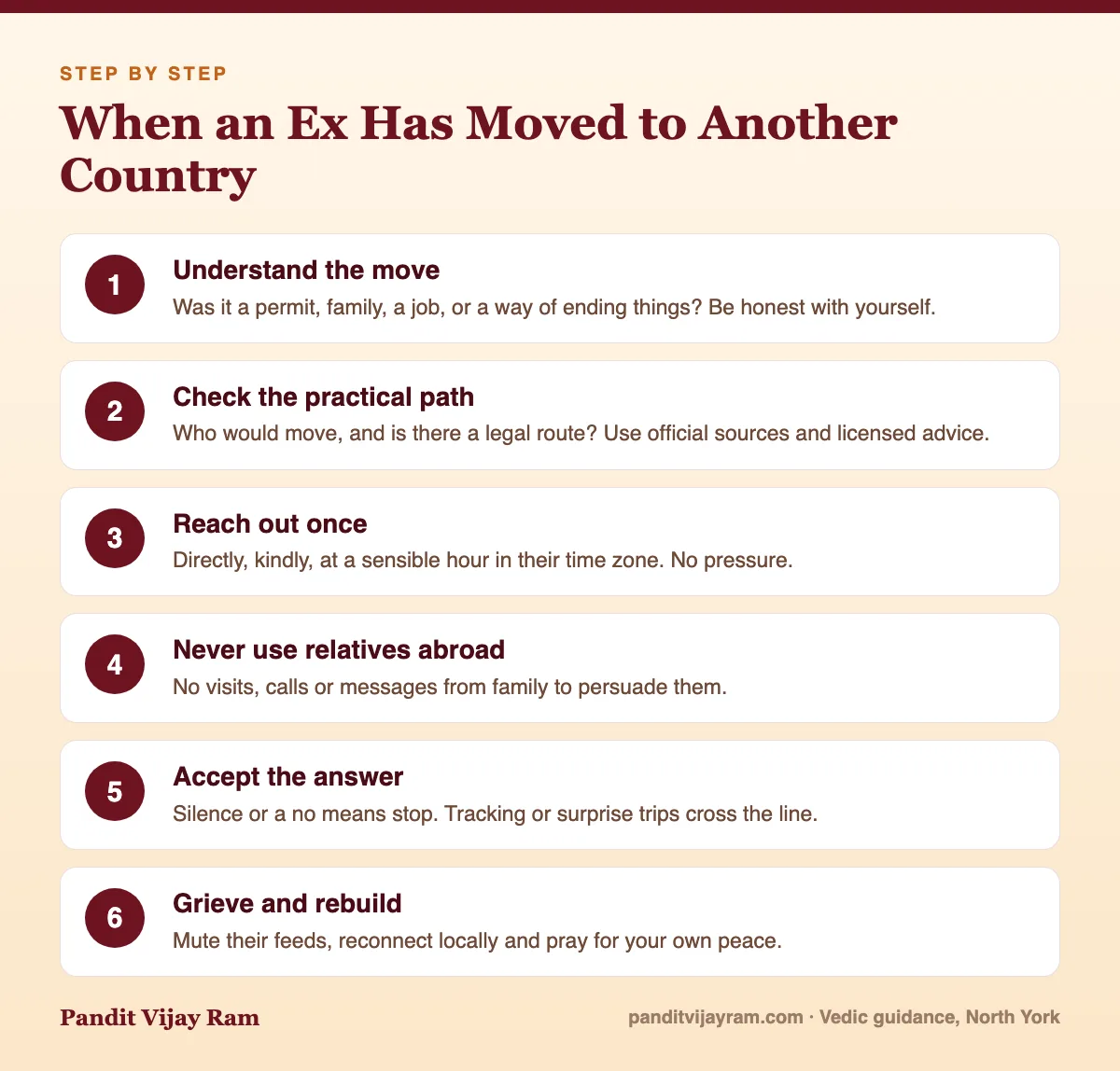
Send one direct, respectful message through a channel they still use, at a reasonable hour in their time zone. Keep it short, acknowledge the distance and their new life, and ask nothing that demands an immediate answer. Do not route messages through their family, colleagues or new friends, and accept silence as a reply.
Distance makes impulsive contact more tempting. Late at night in Toronto, it may be morning where they are, and it is easy to send something you would not send in daylight. A few principles help:
- Check you are welcome. If they blocked you or asked for no contact before leaving, that request still stands. Our guide on what to do when an ex blocked you explains why.
- Write in daylight. Draft the message, sleep on it, then send it at a sensible hour for them.
- Keep it simple. "I hope you are settling in well. I have been thinking about us, and if you are ever open to talking, I would like that. No pressure at all."
- Respect their new context. They may share a home with parents, work long hours or be adjusting to a different culture.
- One message, then wait. Repeated messages across time zones feel relentless.
Our guide on whether you should text your ex includes a decision tree that applies just as well internationally.
If they reply warmly, take it slowly. Video calls can rebuild connection, but they can also recreate old patterns. Talk about the practical questions early, so neither of you invests months in hope that has no path.
When does reaching out across borders become stalking or pressure?
Reaching out becomes stalking or pressure when you keep contacting someone who has said no, track their location or social media obsessively, travel to find them uninvited, create new accounts after being blocked, or ask relatives in their home country to visit or persuade them. These actions frighten people and can be crimes in many countries.
Distance sometimes makes people feel that ordinary boundaries do not apply. They do. Please avoid all of the following:
- Using relatives back home as messengers. Asking your aunt in Punjab, your cousin in Georgetown or a family friend in Manila to visit your ex or speak to their parents puts enormous pressure on them and on their family.
- Turning up in their city. Flying out to surprise someone who has not invited you can be deeply frightening, especially for a woman living with family.
- Contacting their employer, school or new partner.
- Tracking them online. Checking location tags, using shared accounts or asking mutual friends for updates.
- Making new accounts to get around a block.
Repeated, unwanted contact that makes someone fear for their safety can be criminal harassment in Canada, and many other countries have similar laws. Beyond the law, these actions almost always end any remaining chance of reconciliation.
If you are the one being pressured from overseas, you can block, document messages, tell your family clearly that you do not want contact, and report threats to local police.
If you notice you cannot stop checking on your ex, please speak to your family doctor or a counsellor. That pull is not a moral failing, but it does need support. For crisis moments, call or text 988.
How can you cope if your ex moved abroad and moved on?
Coping means grieving two losses at once: the person and the shared future you pictured in one country. Give yourself permission to mourn, reduce online checking, lean on friends and community here, and build routines that anchor you. Spiritual practice can steady you, focusing on your own peace rather than on bringing them back.
When an ex settles abroad and moves on, the grief can feel strangely abstract. There is no chance meeting at a cousin's wedding, no shared neighbourhood, just a profile picture from a city you may never visit. Some practical steps help:
- Mute or unfollow, at least for a while. Watching their new life in real time keeps the wound open.
- Mark the ending. Write a letter you do not send, or light a diya and say a short prayer of release.
- Reconnect locally. Friends, family, your temple, gurdwara or community centre, a sports club or a class.
- Protect your sleep. Avoid late-night scrolling timed to their daytime.
From the Vedic side, the twelfth house is traditionally linked with foreign lands and separation, and the ninth with long journeys. A reading may show that a period of distance or endings is active in your chart. That offers context for why this season feels so hard. It does not mean your ex is destined to return, and no chart can decide that for them.
Through a get ex love back consultation I can look at these themes with you and suggest prayer for your own steadiness. For a longer daily healing routine, see our guide to spiritual healing after a breakup. If sadness lingers for weeks, please also see your family doctor.
The bottom line
When an ex moved abroad, reconciliation needs both mutual desire and a realistic plan for living in one place, including honest checks on work and immigration. Reach out once, directly and kindly, and treat silence as an answer. Tracking, surprise visits and pressure through relatives cross into harassment and destroy trust. If they have moved on, grieve both the person and the future you imagined, and use prayer for your own peace.
Key takeaways
- A move abroad often forces decisions about careers, families and residency.
- Reconciliation needs mutual desire and a practical plan, not hope alone.
- Contact once, directly and at a sensible hour for them.
- Relatives overseas should never be used to pressure an ex.
- Charts may show a season of distance but cannot decide another person's choice.