
Love Problem Solution by Astrology: What a Reading Actually Looks At

When love goes wrong, people want an explanation. Why do I keep choosing the same kind of partner? Why did things change so suddenly last spring? Will this phase pass? Searching for love problem solution astrology often means you want a map, not a miracle. Many of the people who sit with me in North York have already read three online horoscopes and come away more confused. This article walks through what a careful Vedic relationship reading actually examines, in the order an astrologer usually looks at it: the houses of romance and partnership, Venus and the Moon, the navamsa, and the planetary periods that colour a particular year of life. Just as importantly, it sets out what the chart cannot tell you. In more than forty years of reading horoscopes, I have learned that the most useful thing a chart offers is perspective. It can show why a pattern feels familiar and when pressure is likely to ease. The decisions remain with the two people involved.
What does a love problem astrologer look at in a birth chart?
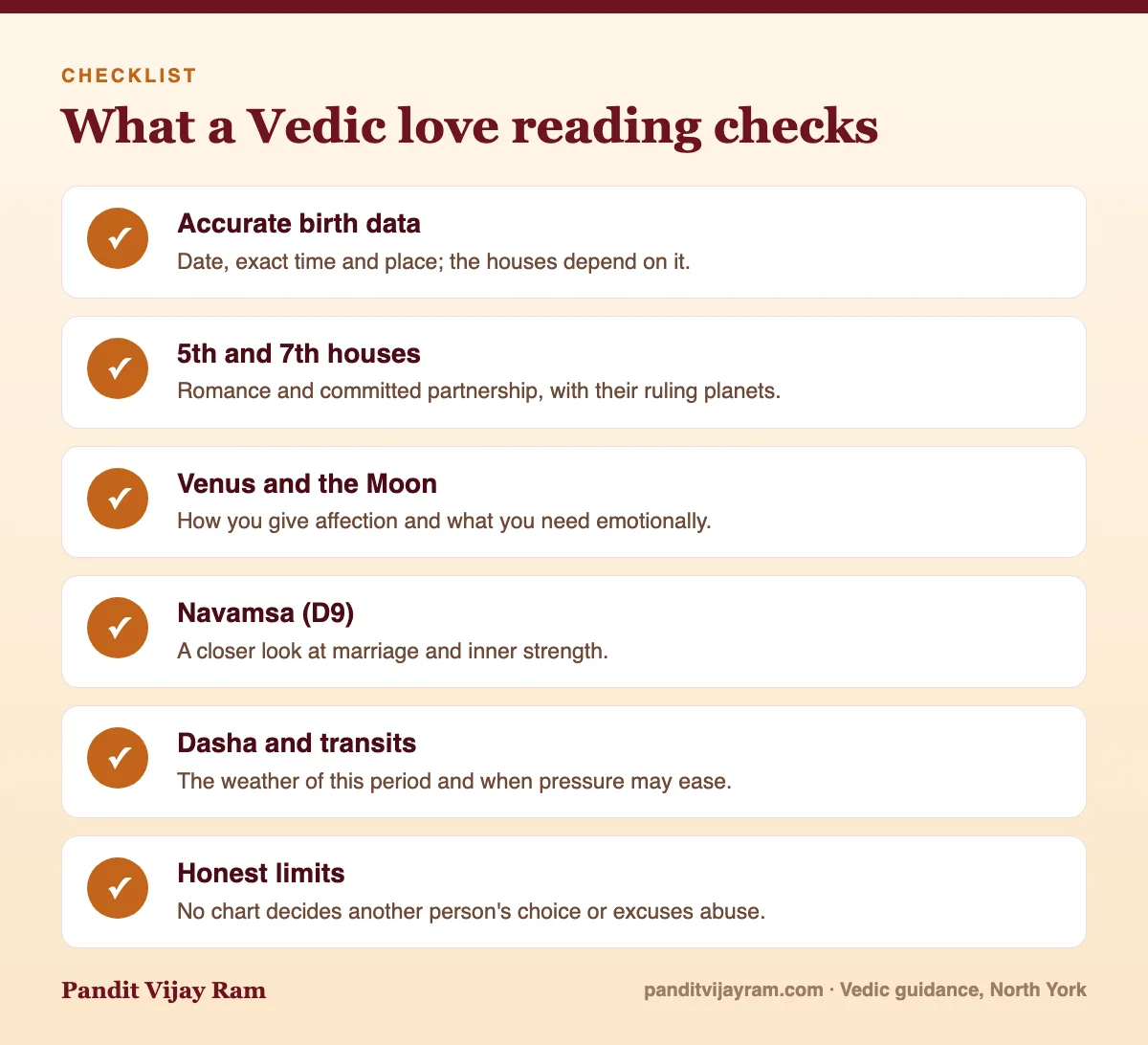
A careful astrologer starts with accurate birth details, then reads the ascendant, the 5th and 7th houses and their lords, Venus, the Moon, Mars and the navamsa chart. Next comes the running dasha and major transits. If both partners agree, the two charts are compared. The aim is to understand patterns, not to issue a verdict.
A relationship reading has a rough order. Knowing it helps you judge whether the person reading your chart is being thorough.
- Birth data check. Date, exact time and place. A time that is off by even half an hour can change the ascendant and the houses.
- The whole chart first. The ascendant and its lord describe temperament, which shapes how you love.
- Romance and partnership. The 5th house, the 7th house and the planets ruling them.
- Key planets. Venus for love and pleasure, the Moon for emotional needs, Mars for desire and conflict. Many astrologers also read Jupiter as a significator of the husband in a woman's chart.
- Navamsa (D9). The ninth-division chart, traditionally used to look more closely at marriage and inner strength.
- Timing. The running mahadasha and antardasha, and slow transits of Saturn and Jupiter.
- The partner's chart, only with their knowledge and agreement.
A good reader also asks you questions. What actually happened? How long has it felt like this? Is anyone afraid? The chart makes sense only against the real story.
Vijay Ram ji's love problem guidance follows this order, and a fuller written kundli reading is available for those who want the whole chart in detail.

What do the 5th and 7th houses show about love?
The 5th house is traditionally linked with romance, affection, creativity and courtship, while the 7th house governs committed partnership and marriage. Their condition, their lords and the planets placed in or aspecting them describe how a person approaches love and commitment. Difficult placements suggest areas needing effort, not a destiny of failure.
Think of the 5th as falling in love and the 7th as living with someone.
The 5th house describes:
- How you express affection and attraction.
- Playfulness, courtship and early romance.
- In traditional texts, also children and creative intelligence.
The 7th house describes:
- What you seek in a long-term partner.
- How you handle compromise and shared life.
- Business partnerships and public dealings as well.
What astrologers look for in each:
- The sign on the house and the condition of its ruling planet.
- Planets sitting there: Saturn may slow or deepen commitment; Rahu may bring unconventional bonds; Jupiter usually protects.
- The link between the 5th and 7th lords. A strong connection is often read as romance growing into marriage.
None of these is a final word. A Saturn in the 7th is one of the most feared placements, yet it is also associated with loyal, lasting marriages that settle with age. The same factor reads differently once the rest of the chart is considered.
Specific Venus and 7th house remedies are covered in our separate guide, Venus and 7th house love remedies.
How do Venus and the Moon affect relationships in astrology?
Venus, or Shukra, represents love, attraction, pleasure and harmony, so its sign, house and strength show how a person gives and receives affection. The Moon represents the mind and emotional needs. When Venus is afflicted or the Moon is restless, relationships often feel harder, and remedies aim to steady these two planets.
If the houses show the stage, Venus and the Moon show two of the main actors.
Venus is read for:
- Taste in partners and what feels romantic to you.
- Comfort with intimacy and pleasure.
- Whether harmony comes easily or needs work.
A strong Venus in a friendly sign usually eases these. Venus very close to the Sun, called combust, or joined with harsh planets, can show sensitivity or difficulty receiving love.
The Moon is read for:
- Emotional needs: security, freedom, reassurance or space.
- Mood under stress.
- How you react when you feel neglected.
A Moon with Saturn often seeks reliability and fears abandonment. A Moon with Rahu can feel things intensely and swing quickly. Neither is bad; both are worth knowing.
Comparing two Moons is the heart of Vedic compatibility, which our article on Moon sign compatibility covers in detail.
The Moon is also where self-care counts most. Sleep, food and routine settle the Moon better than any gem. If low mood lasts for weeks, please see your family doctor as well.
Can dashas and transits explain a hard phase in a relationship?
Often, yes. The Vimshottari dasha system divides life into planetary periods, and a period of Saturn, Rahu or Ketu, or one involving the 6th, 8th or 12th lords, can coincide with strain. Saturn transiting the Moon or the 7th house is another common pressure. These show the weather of a period, not its outcome.
Timing is the part of a reading people find most useful. It explains why a relationship that was easy for years became heavy, and it gives a sense of when that weight may lift.
Common timing factors an astrologer checks:
- Mahadasha and antardasha. The major and sub-period running now, and which houses their planets rule.
- Sade Sati. Saturn's roughly seven-and-a-half-year passage over the natal Moon, often felt as emotional pressure.
- Saturn or Rahu over the 7th. Can test commitment and bring responsibilities to the surface.
- Jupiter's transits. Often coincide with easier, more hopeful phases.
How to use timing sensibly:
- Treat a hard period as a reason for patience and care, not a reason to give up.
- Avoid big decisions in the middle of an intense emotional transit if you can wait.
- Use the period for practical work: counselling, clearer communication, fewer assumptions.
Be wary of anyone who uses timing to frighten. A difficult dasha is a season, and seasons end. For couples whose strain shows up as constant quarrels, our guide on husband and wife arguments pairs chart factors with communication tools.
What can't astrology decide about a love problem?
A chart cannot decide whether someone will come back, whether you should stay, or whether a person loves you. It cannot override consent, excuse abuse or replace counselling. It shows tendencies and timing. The choices, the conversations and the care belong to the people in the relationship.
Honest limits are what make a reading trustworthy. Here they are without softening.
- Another person's choice. You may see a favourable period for reconciliation, but your former partner decides whether to return.
- Whether to stay. A chart can describe strain. Only you can weigh your safety, your children, your values and your heart.
- Abuse. No planetary placement explains or excuses violence, threats or control. If you are afraid, contact the police, and in an emergency call 911.
- Mental health. Anxiety and depression are real conditions. If you feel hopeless, call or text 9-8-8.
A simple decision rule for using any reading:
- If the advice respects both people's free will, consider it.
- If it suggests practical steps you can take yourself, try them.
- If it claims to control the other person, or demands escalating payments, walk away.
Many people searching for love solutions find that the chart helps most when combined with ordinary support: a counsellor, an honest friend, a family elder. Vijay Ram ji does not perform rituals to override anyone's will; our article on whether love back spells work explains why.
The bottom line
Love problem solution astrology works best as careful reading, not a promise. A thorough astrologer checks the 5th and 7th houses, Venus, the Moon, the navamsa and the running dasha to understand patterns and timing in your relationship. The chart cannot decide another person's feelings, excuse abuse or replace counselling. Used with honesty, it offers perspective and patience while the real choices stay with the two of you.
Key takeaways
- Accurate birth time matters; the houses depend on it.
- The 5th house shows romance; the 7th shows committed partnership.
- Venus describes love; the Moon describes emotional needs.
- Dashas and transits show the weather of a period, not its ending.
- No chart decides another person's choice or excuses abuse.